
No products in the cart.
THE TONIIK EDIT · BREAST HEALTH
We don’t have an awareness problem.
We have a prevention problem.
Prevention, Not Awareness
By Monique Gandon, MSN, FNP-BC · TONIIK Functional Medicine & Aesthetics
From our October 17 breast-health event · Studio City
Every October you are reminded that breast cancer exists. Everyone already knows. What almost nobody ever hands you is a plan.
We spent a morning at our Studio City office doing exactly that — walking women through what their own bodies are actually doing, what their screening does and doesn't see, and which of this is genuinely in their control. Here is the short version, for the women who couldn't be in the room.

01 / BREAST HEALTH
Start with your breast density
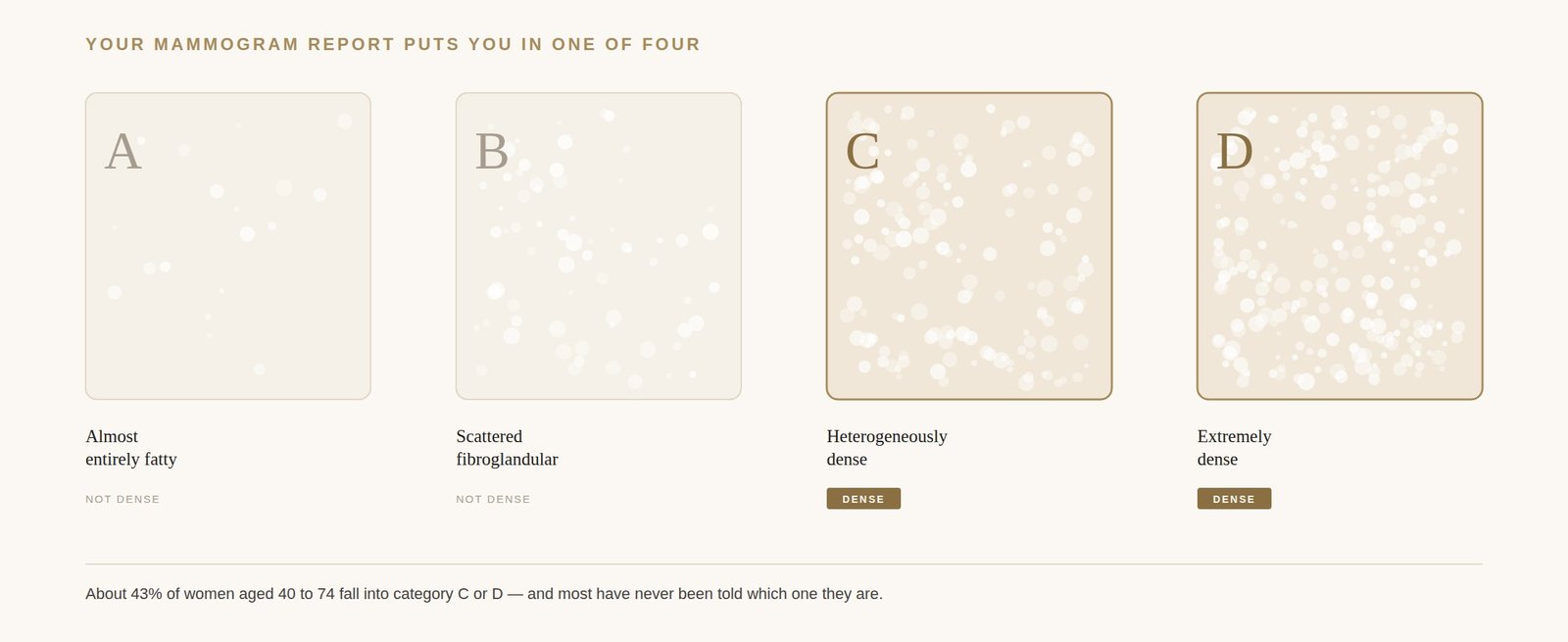
About 43% of women aged 40 to 74 have dense breast tissue. Dense simply means more fibrous and glandular tissue and less fat. It is not a disease and it is not something you did.
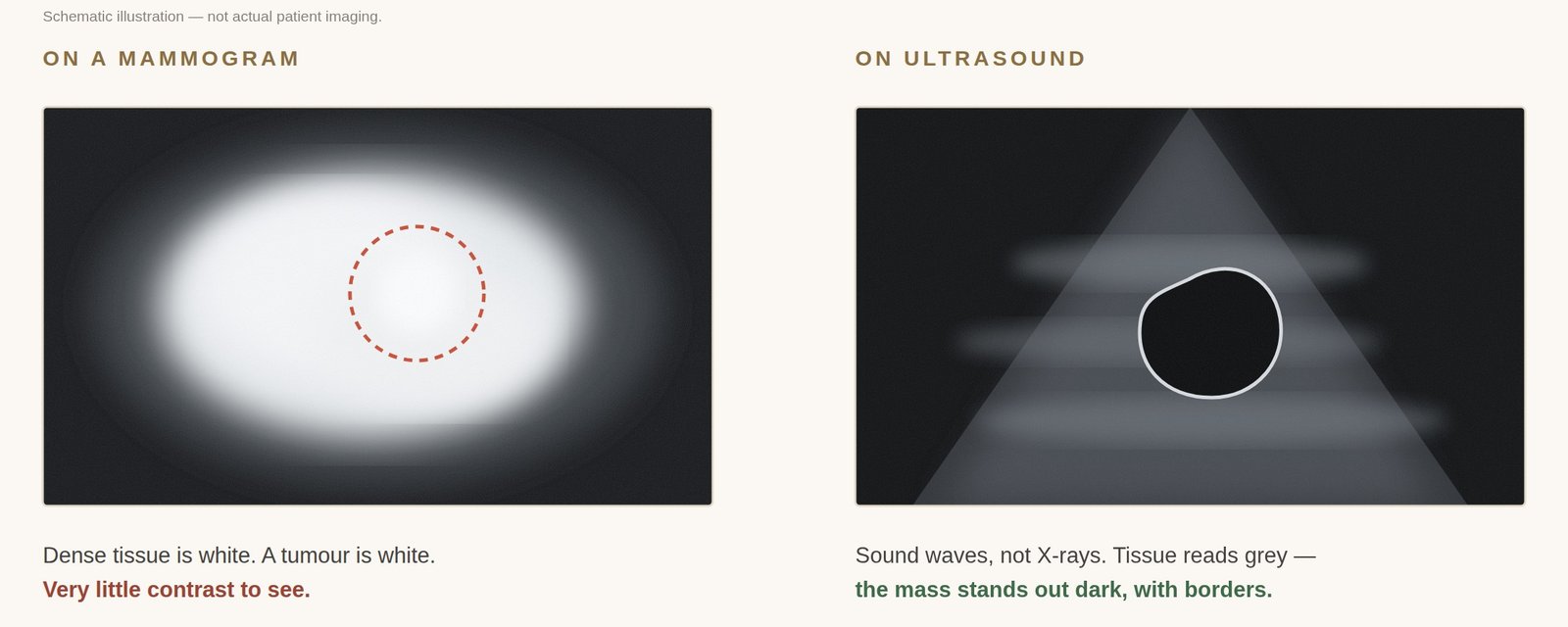
It matters for a mechanical reason. On a mammogram, dense tissue shows up white. So do tumors. Looking for one in the other is genuinely hard, and the denser the tissue, the harder it gets.
Here is what changed, and almost nobody knows it: since September 10, 2024, U.S. mammography facilities covered by FDA rules must notify patients whether their tissue is dense. Your provider’s report includes a density category. This information is provided automatically in the patient summary. The federal wording says it plainly: dense tissue makes cancer harder to find on a mammogram and raises the risk of developing it.
Your report sorts you into one of four categories. C and D count as dense.
- A — almost entirely fatty
- B — scattered fibroglandular
- C — heterogeneously dense
- D — extremely dense
 Tap or click to enlarge
Pull up your last mammogram report tonight and find your letter. If the report predates September 2024 it may not be there — call and ask.
02 / BREAST HEALTH
Density isn't just a visibility problem
This is the part that rarely gets explained. Dense tissue doesn't only hide things. It raises the odds there is something to hide.
Women with extremely dense breasts have roughly four times the risk of women with fatty breasts. And in a study of more than 200,000 women, breast density was the single largest contributor to breast cancer risk before menopause — 39.3% of cases in the study’s premenopausal population, compared with 8.7% attributable to family history. These population-level estimates do not predict an individual woman’s risk.
So the women whose mammogram is least able to give them a clear answer are the same women who most need one.
 Tap or click to enlarge
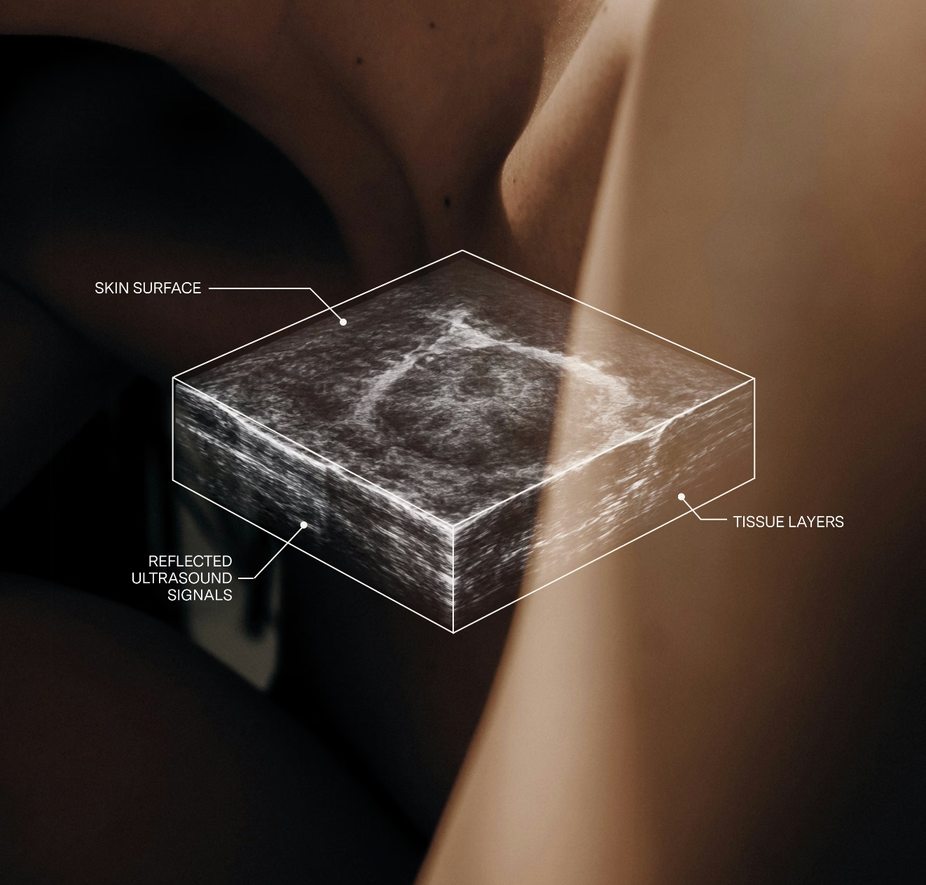
That is why supplemental ultrasound exists for dense tissue. Ultrasound uses sound rather than X-rays and can provide additional information in dense tissue. It supplements mammography rather than replacing it. In a study of more than 15,000 women with dense tissue, adding automated breast ultrasound to mammography found an additional 1.9 cancers per 1,000 women — the additional cancers averaged 12.9 mm, and 93.3% were invasive. The study also found more recalls for further evaluation. These results support discussing supplemental screening in the context of your individual risk.
 Tap or click to enlarge
03 / BREAST HEALTH
Most breast cancer is not inherited
Only about 5 to 10% of breast cancers are hereditary. For the overwhelming majority there is no single inherited gene to point to.
But that small slice is where knowing changes everything — so it's worth understanding what BRCA actually is.
BRCA1 and BRCA2 are not cancer genes. They are repair genes. Your body copies DNA billions of times a day, and copying that fast makes mistakes. These genes find those mistakes and fix them. You carry two copies of each, one from each parent, and one working copy is enough to do the job.
If you inherit a broken copy, every cell in your body is already one hit in. You only need one more unlucky hit instead of two. That is why it's described as lifetime risk, and why it tends to appear younger. Carrying one means a breast cancer risk of over 60% in a lifetime, against about 13% for everyone else. Roughly 1 in 400 people carry one — and most of them have no idea.
The part almost everyone gets wrong
BRCA passes down from your father exactly as often as from your mother. A man can carry it, never get sick a day in his life, and pass it to his daughter. Which is why so many women say they have no family history — they only ever counted their mother's side.
Ask about his side specifically, and count all of this, on either side:
- Breast cancer in a blood relative at 50 or younger
- Ovarian cancer, at any age
- Male breast cancer, ever
- Two or more blood relatives with breast cancer
- Pancreatic cancer, or advanced prostate cancer
04 / BREAST HEALTH
Every woman should have a formal risk assessment by age 25
Not a feeling about whether you're high risk — an actual calculation. The model takes your family history, your reproductive history, any previous biopsies and your breast density, and returns one number: your lifetime risk.
It matters because of where the thresholds sit. A calculated lifetime risk of 20% or more may qualify you for annual MRI alongside mammography. The starting age depends on your risk factors and the imaging test, so your clinician should personalize the schedule. The American College of Radiology recommends risk assessment by age 25 to identify who may benefit from earlier or additional screening.
It takes a few minutes. We do it in consultation, and it is the single most useful thing most women in their thirties have never had done.
05 / BREAST HEALTH
What actually moves the needle
Four things worth knowing, none of which anyone tends to explain properly.
Alcohol
Risk rises roughly 7% for every 10 grams of alcohol a day — that's under one US drink. At two to three a day it runs about 32% higher. The mechanism is estrogen: alcohol changes how you metabolize it. It's dose-dependent, which means less genuinely is better, and almost nobody has ever said that out loud to you.
Overnight shift work
The World Health Organization classifies it as probably carcinogenic to humans. The suspected mechanism is circadian disruption and suppressed melatonin. If your work includes regular overnight shifts, protect the sleep window you do have.
Body composition after menopause
Weight-linked breast cancer risk shows up after menopause, which makes your thirties and forties the easiest window to influence it. What you build now is what you carry in.
Reproductive history
Risk falls about 7% with each birth and a further 4.3% for every twelve months of breastfeeding. We include this as context, not a prescription — it's part of why rates in younger women have shifted at all.
06 / BREAST HEALTH
Hormones are not one thing
“Hormones cause breast cancer” came from one arm, of one trial, in 2002 — and has been quoted ever since as though it were the whole story. It never was. Two things changed this year that most women haven't heard:
- February 2026 — the FDA approved labeling changes for six menopausal hormone therapy products, removing cardiovascular, breast-cancer and probable-dementia risk statements from their boxed warnings. This does not mean those treatments are risk-free.
- October 2026 — the American College of Physicians recommended hormone therapy as a first-line treatment for menopausal hot flashes and night sweats in appropriate patients. The regimen depends in part on whether a person has a uterus.
And when you look at the trial itself: women with a prior hysterectomy who received conjugated equine estrogen alone had 22% lower breast-cancer incidence and 40% lower breast-cancer mortality than those assigned placebo in long-term follow-up. The increase appeared in the arm that paired estrogen with a synthetic progestin, in women averaging 63 and a decade past menopause. Micronized progesterone — body-identical, what we actually prescribe — was never studied in that trial at all; observational cohort findings suggest a different risk profile, but do not establish that it is risk-free.
Whether hormone therapy is appropriate depends on your symptoms, health history, formulation and timing. It is a treatment decision to make with your clinician, not a breast-cancer prevention strategy.
07 / BREAST HEALTH
The exposure nobody is measuring
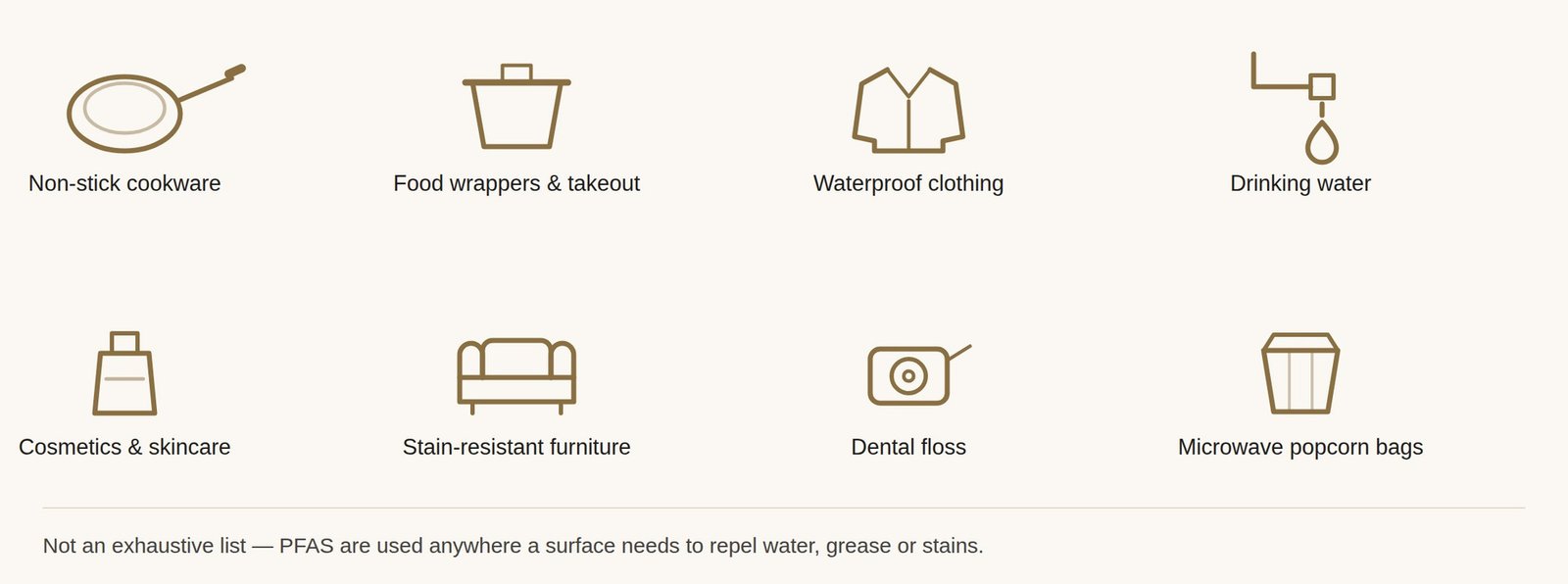
A 2024 analysis from the Silent Spring Institute and UC Berkeley identified 921 chemicals with traits that can promote breast cancer. 278 of them cause mammary tumors in animals. Roughly 90% are things people encounter routinely — consumer products, food and drink, pesticides, workplaces.
 Tap or click to enlarge
The named ones live in ordinary places: PFAS in non-stick cookware and waterproof fabric, phthalates in anything listing “fragrance,” parabens in skincare, bisphenols in can linings and receipt paper.
Here is the encouraging part. In a 2023 pilot study, 41 women swapped their everyday products — shampoo, lotion, deodorant — for versions without parabens or phthalates. Nothing else changed. After 28 days, their urinary levels fell, and in breast tissue sampled before and after, 19 of 26 cancer-related genes had shifted away from the pro-carcinogenic pattern.
That study measured gene expression rather than cancer outcomes, and it was small and uncontrolled — so we hold it lightly. But the direction is the point: four weeks, the same products minus two ingredients, and the cellular markers moved.
08 / BREAST HEALTH
Know your normal
You are the only person who touches your body every day. But you'll only notice a change if you know what it felt like before. Cover the whole area three ways, every time:
- Up and down — underarm to ribcage, strip by strip
- Side to side — the same area again, the other direction
- Circle around — spiralling inward toward the nipple
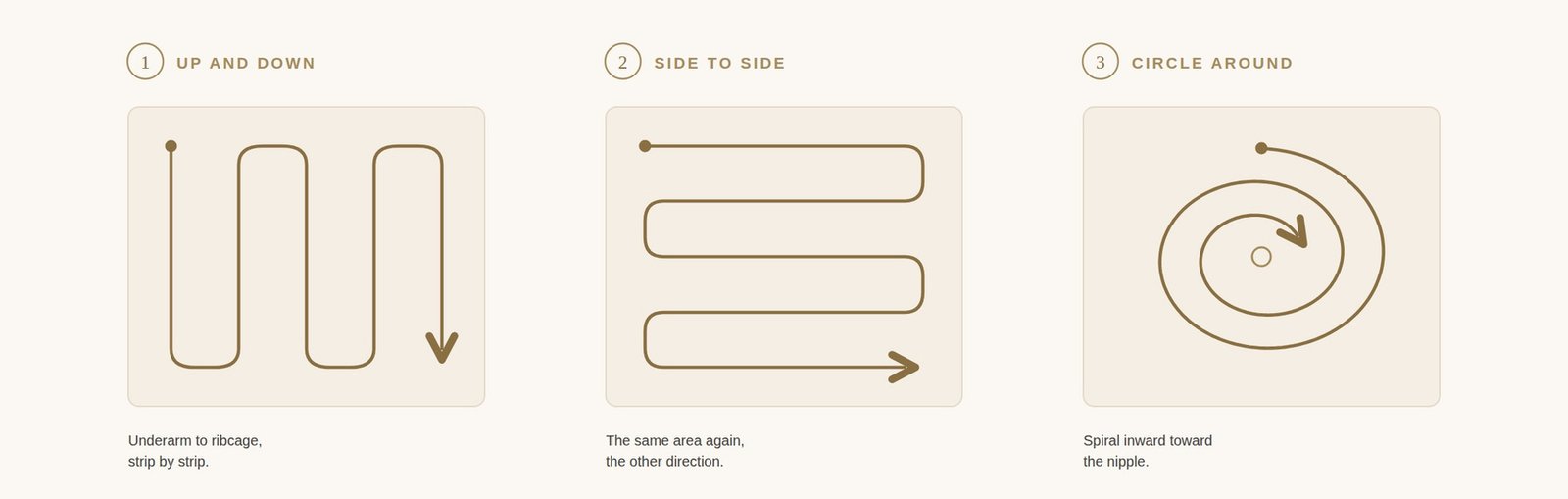 Tap or click to enlarge
Use the pads of your three middle fingers, and press at three depths at every spot before moving on: light just under the skin, medium through the middle, firm all the way down to the ribs. Most women only ever press lightly, which means they never feel anything sitting deep against the chest wall.
Do it in three positions — in the mirror with your hands on your hips, lying down with a pillow under that shoulder, and in the shower with soapy hands. A few days after your period ends, when tissue is least tender.
Call us about
- A new lump or thickened area that doesn't come and go
- Any lump or change in the underarm
- A change in size, shape or contour
- Dimpling or puckering of the skin
- Redness, flaking or crusting of the nipple or skin
- Any nipple discharge
Changes that can be common
- Tenderness and lumpiness that rises and falls with your cycle
- A ridge of firmer tissue along the underside of both breasts
- Breasts that aren't quite the same size as each other
Most breast changes are not cancer. Call us anyway — that's what we're here for.
09 / BREAST HEALTH
One more, and it matters in your thirties
A lump while pregnant or nursing is not automatically a clogged duct.
Breast changes in pregnancy and breastfeeding get explained away — by patients and by clinicians. Everything feels lumpy, everything is changing, and there's always a reason not to worry about it yet. That is the single biggest reason breast cancer found in this window gets found later than it should be.
The rule: contact your clinician promptly about a new or persistent lump. They can decide when imaging is needed; you do not need to wait two weeks before asking for help. Ultrasound is safe in pregnancy and safe while you're nursing. You do not have to wean to be checked.

Your baseline, your numbers, your plan
If you've read this far and realised you don't know your density category, have never had your risk calculated, or have never asked about your father's side — that's the appointment.
We'll run your formal risk assessment, go through your screening history, and build you a plan that fits your actual risk rather than your age bracket.
Text us to book a consultation
Prefer to call? (818) 436-6386